 Marketing Attorney Blog
LP Magazine — Acronyms Reshaping Law Firm Marketing: AI, MSOs, and ABSs


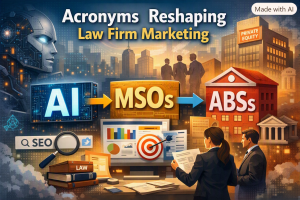
AI, MSOs and ABSs
In my September/October 2026 ABA Law Practice Magazine column, “Acronyms Reshaping Law Firm Marketing: AI, MSOs, and ABSs,” I examine three forces that are simultaneously—and fundamentally—restructuring how law firms approach marketing, intake, staffing, and client acquisition. For decades, law firm marketing operated on limited budgets, constrained by ethics rules that kept outside capital at bay and by a culture that treated business development as an afterthought. That era is ending. Management services organizations (MSOs), alternative business structures (ABSs), and artificial intelligence (AI) are converging to create a new ecosystem in which marketing is no longer peripheral but central to firm strategy, investment, and operations.
MSOs and ABSs are introducing outside capital, new ownership models, and nonlawyer expertise into the legal marketplace. In some firms, marketing and intake are shifting to sister companies that operate outside traditional law‑firm structures. Private equity is flowing into personal injury and mass tort practices, where high client‑acquisition costs and long case‑resolution timelines make outside funding particularly attractive. These arrangements raise cultural and ethical questions—especially around oversight, fee‑sharing, and multijurisdictional practice—but they also create opportunities for marketers who suddenly find themselves working within organizations that treat marketing as infrastructure rather than overhead.
At the same time, AI is rewriting how marketing is produced and how clients find lawyers. Tools that generate content, design reports, and build campaigns in minutes are reshaping marketing departments and redefining the skills required to operate them. SEO is giving way to “answer engineering,” where visibility inside AI ecosystems matters as much as traditional search rankings. Yet AI also introduces compliance risks: advertising rules still apply, and models often fail to recognize them. As firms reduce headcount or reassign roles, the need for human oversight—particularly from professionals with legal acumen—becomes more important, not less.
The column explores how these three developments intersect and why their combined impact will reshape the marketer’s role heading into 2027. Whether or not a firm adopts an MSO structure, pursues ABS licensing, or deploys AI at scale, every lawyer and marketer must understand how these forces influence client acquisition, regulatory compliance, and competitive positioning.
If you are blocked from reading the column behind the ABA paywall, it is provided below in its entirety.
Summary
- Outside capital, new firm structures (MSOs and ABSs), and AI are simultaneously reshaping how law firms fund, staff, and execute marketing.
- Private equity–backed MSOs and regulator‑approved ABSs are shifting marketing and intake outside the traditional firm, creating both opportunity and cultural disruption for marketers.
- AI is transforming client acquisition and content production while introducing compliance risks that require human oversight and new skillsets inside marketing teams.
For most of its relatively brief history, the legal profession has treated marketing as the department funded last. Capital was scarce, ethics rules kept outsiders out, and a partner’s idea of business development was a round of golf. Three new components are now dismantling that arrangement all at once: management services organizations (MSOs) and alternative business structures (ABSs) are routing real money and outside expertise into firms, while artificial intelligence is rewriting how legal marketing gets made and how prospective clients find a lawyer.
This column is not intended to be about AI, which might make it the first thing you read today that is not all about it. AI is now an unavoidable force in law firm marketing (and almost everything in existence), supercharging the production of marketing materials even as it threatens the roles historically responsible for that work. Recently, a marketing design shop quoted me two weeks and $3,000 to turn a Word document into a polished, client-ready report with a matching slide deck. That afternoon, my daughter urged me to subscribe to Claude for $20 a month. I did—and within 10 minutes had a refined report and a full slide deck, saving half a day of work and $3,000. It also left me wondering how much business that agency, and many like it, are about to lose.
And headcount is part of the story. The writer who no longer needs to write may be replaced by someone whose job is to ensure the firm is visible inside AI ecosystems. Yesterday’s SEO is becoming today’s answer engineering. AI may take away and give back in equal measure. So the real question is: What other acronyms are about to reshape the law firm marketer’s world as 2027 approaches?
Forget a Seat at the Table—Am I in the Same Building?
It is one of the first questions a candidate asks me when I’m involved in hiring a law firm marketing executive: Do I have a seat at the table? My answer is that it’s earned, not given—you build the authority and trust that makes the partnership decide you belong there. But what if the table is on a different floor or in a different building, state, or even country? MSOs and ABSs might mean you aren’t really working at the law firm at all, but at the sister business—the nonlegal side—that staffs management, marketing, technology, and other non–law practicing personnel.
If you were irked by the term “nonlawyer” at your law firm, how about being in the nonlawyer business outside it entirely? Depending on the firm and practice area, the concept might be a win: Your new MSO may be funded by private equity pouring millions into the marketing machine. Or you might find yourself feeling detached from the attorneys and practice groups.
Should I Embrace an MSO?
The MSO model splits a practice into two entities—a lawyer-owned firm that does the legal work and collects fees, and a separately owned management company that runs everything else, including marketing and intake. Because the management company never shares legal fees, the arrangement provides an end run around of sorts for ABA Model Rule 5.4 and works in most jurisdictions. The ABS model goes further, allowing nonlawyers to own a piece of the firm itself, but only where a regulator permits it. Arizona remains the best-known ABS state, though its rules keep shifting—the Judicial Council recently tightened licensing requirements over the State Bar’s objection that they don’t go far enough. California, Colorado, and Illinois have thrown up roadblocks, restricting nonlawyer influence over firm operations and banning fee-sharing with out-of-state ABSs. ABS only works where it’s allowed, creating real confusion in a world of multijurisdictional practice.
If you’ve seen private equity work in your personal life—I’ve seen it firsthand in physicians’ offices—it isn’t pretty, with bean counters maximizing profit while minimizing service. Pardon me if I get squeamish, as both an ethics lawyer and a marketer: The ethics side worries about oversight and interference; the marketer side sees a massive shift coming to marketing operations.
It should come as no surprise that activity surrounds personal injury and mass tort, the most marketing-intensive corner of the profession. Rafi Law Group recently secured a $125 million private equity investment to launch Rafi Legal Services, a national MSO valued at $450 million. Louisiana’s Dudley DeBosier launched a similar arrangement bundling marketing, finance, and technology. Arizona, meanwhile, has licensed more than 150 ABS firms. The pattern isn’t an accident: Personal injury and mass tort carry high upfront client-acquisition costs, recovered only when cases resolve, sometimes years later—exactly the cash-flow gap outside capital is built to close. When investors look at a law firm, the marketing engine is often the asset they’re actually buying.
But MSOs are being developed and incorporated in different ways. Big Law. Small Law. Mid-Sized Law. They are being developed as an independent extension of a law firm. In some cases, they are the lead generation and intake function. In others, they are developed more as a spinoff business with the hope of obtaining third-party funding later. There are law firms now positioning themselves the way a company might ahead of an IPO—a windfall exit strategy for retiring partners, business expansion that needs fueling, or simply a way to better monetize marketing and corresponding staffing. In other words, as fee-sharing limitations ease, marketers may be positioned to profit more directly. All of this can amount to marketing being treated as key infrastructure rather than overhead.
AI Rewrites How Clients Find You—and How Marketing Is Produced
Remember SEO? Keywords? AdWords? Organic search? Yeah, they still exist. But with AI increasingly replacing search, the goal is to be the answer to an AI query. AI is also remaking production—drafting content, generating campaign ideas, running agentic workflows. For a lean firm, that’s leverage; for the people who used to do that work, it’s something else.
Two caveats keep this from being a panic. “AI” is a convenient label for cuts that owe as much to cost pressure as technology, and replacement results are mixed. Employers who cleared out content teams are rehiring people who can supervise and sharpen AI output. The writers who survive bring legal acumen, voice, and a compliance instinct the model can’t fake. That matters because the advertising rules still apply, and AI doesn’t know them. Trust me. It thinks it knows them. It does not. One Arizona ABS was already disciplined over advertising and intake failures, including inadequate disclosure of a co-counsel arrangement—exactly the kind of mistake that multiplies when fewer humans review more AI-made content.
The Convergence of AI, MSO, and ABS
Put them side by side, and the overlap is hard to miss. The capital flowing through MSOs and ABSs is buying marketing (often through lead generation) and intake. The practice areas leading both are the one that lives or dies by client acquisition. AI is reshaping that same function—changing how clients find lawyers and who inside the firm is doing the reaching.
The takeaway holds whether or not you ever entertain an MSO term sheet or an ABS license. If you think it won’t impact your legal career, think again. Audit how your firm shows up in AI-generated answers, not just search rankings. Monitor not only your investments in people, infrastructure, and technology, but also what everyone around you is doing. Because if you were uncomfortable when the Bates decision first allowed law firms to advertise, this is going to make that look like child’s play.