 Marketing Attorney Blog
LP Magazine — Acronyms Reshaping Law Firm Marketing: AI, MSOs, and ABSs


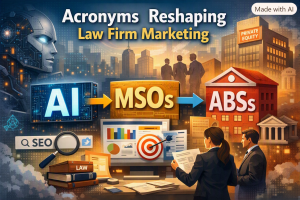
AI, MSOs and ABSs
In my September/October 2026 ABA Law Practice Magazine column, “Acronyms Reshaping Law Firm Marketing: AI, MSOs, and ABSs,” I examine three forces that are simultaneously—and fundamentally—restructuring how law firms approach marketing, intake, staffing, and client acquisition. For decades, law firm marketing operated on limited budgets, constrained by ethics rules that kept outside capital at bay and by a culture that treated business development as an afterthought. That era is ending. Management services organizations (MSOs), alternative business structures (ABSs), and artificial intelligence (AI) are converging to create a new ecosystem in which marketing is no longer peripheral but central to firm strategy, investment, and operations.
MSOs and ABSs are introducing outside capital, new ownership models, and nonlawyer expertise into the legal marketplace. In some firms, marketing and intake are shifting to sister companies that operate outside traditional law‑firm structures. Private equity is flowing into personal injury and mass tort practices, where high client‑acquisition costs and long case‑resolution timelines make outside funding particularly attractive. These arrangements raise cultural and ethical questions—especially around oversight, fee‑sharing, and multijurisdictional practice—but they also create opportunities for marketers who suddenly find themselves working within organizations that treat marketing as infrastructure rather than overhead.

 It was once again my privilege to serve as editor for the

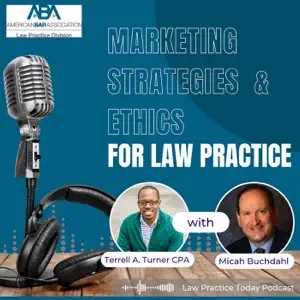 In the January 20, 2025, episode of the American Bar Association’s Law Practice Podcast, host Terrell Turner discusses the complexities of legal marketing with me in this 30-minute discussion available on americanbar.org as well as in your favorite podcast library, including Spotify and Apple.
 It would seem like a no-brainer. You or a family member, relative or friend needs a lawyer. Hey, I’m a lawyer. I know lots of lawyers. That should be easy. But in many cases, it is not. We know the practice areas we know. And in many cases, those are not necessarily typical consumer-facing ones. And I can’t tell you how many times I’ve had commercial real estate attorneys complain to me about getting calls from Jane Doe for a residential commercial real estate transaction. Or an employment lawyer getting a call from John Doe to represent him against the very company that is your client. I remind them that the public does not typically know the difference between plaintiff side and defense, or a real estate attorney handling multi-million-dollar commercial transactions and not interesting in reviewing your kid’s college apartment lease (which many of us have done). This all traces back to us—the “educated” consumer that is a lawyer and needs a lawyer. It should be so simple.