Articles Tagged with “ABA Law Practice Magazine”

Published on:

Copilot_20260910_200403-300x200

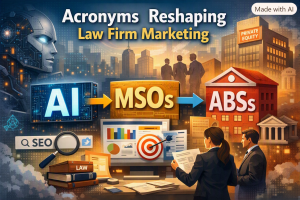
AI, MSOs and ABSs

In my September/October 2026 ABA Law Practice Magazine column, Acronyms Reshaping Law Firm Marketing: AI, MSOs, and ABSs, I examine three forces that are simultaneously—and fundamentally—restructuring how law firms approach marketing, intake, staffing, and client acquisition. For decades, law firm marketing operated on limited budgets, constrained by ethics rules that kept outside capital at bay and by a culture that treated business development as an afterthought. That era is ending. Management services organizations (MSOs), alternative business structures (ABSs), and artificial intelligence (AI) are converging to create a new ecosystem in which marketing is no longer peripheral but central to firm strategy, investment, and operations.

MSOs and ABSs are introducing outside capital, new ownership models, and nonlawyer expertise into the legal marketplace. In some firms, marketing and intake are shifting to sister companies that operate outside traditional law‑firm structures. Private equity is flowing into personal injury and mass tort practices, where high client‑acquisition costs and long case‑resolution timelines make outside funding particularly attractive. These arrangements raise cultural and ethical questions—especially around oversight, fee‑sharing, and multijurisdictional practice—but they also create opportunities for marketers who suddenly find themselves working within organizations that treat marketing as infrastructure rather than overhead.
Published on:

Conferences represent one of the single largest line items in many law firm business development budgets — and one of the most consistently squandered. In a recent column for the May/June 2026 ABA Law Practice Magazine, Making Conferences Count: Converting Visibility into Business, I offer a candid take on why most lawyers leave conferences with little to show for their time and expense, and what it takes to convert that visibility into business. From the misguided habit of traveling across the country just to rack up CLE hours, to hiding in hotel rooms between sessions, to signing sponsorships without asking whether they deliver real engagement, the column dismantles the passive approaches that keep conference ROI low — and replaces them with a disciplined, intentional framework. If your attorneys are hitting the road this season, this is required reading before they board the plane.

If you are blocked from reading the column behind the ABA paywall, it is provided below in its entirety.

Making Conferences Count: Converting Visibility into Business

Published on:

Legal Netlink Alliance

Law Firm Referral Networks

Referral networks may seem like relics in an era dominated by digital marketing, but the right network can still deliver steady, high‑quality work and expand a firm’s reach. After more than 25 years evaluating these groups, I’ve found that their value depends on fundamentals: strong leadership, high‑caliber member firms, and a realistic understanding of the full cost of participation. When those elements align, networks can become reliable engines of referrals, reputation, and professional community. My latest marketing column, in the January/February 2026 issue of ABA Law Practice, suggests Law Firm Referral Networks Make Sense If They Make Cents.

Recently, I’ve had the opportunity to work closely—on behalf of a law firm member—with the Legal Netlink Alliance (LNA), a global association of small and midsize independent law firms. Even in a relatively short time, I’ve watched genuine trust take root and real friendships form among its members. Because the network is intentionally composed of smaller firms and its U.S. conferences are intimate by design, it’s remarkably easy to build meaningful connections. I’ve already met another Rabbi’s kid (like me), a Chicago sports fan who always thinks of me when the Phillies or Eagles are relevant, and even found a lawyer in the Midwest who helped me navigate an unexpected traffic stop—best not to ask.

Published on:

In a digital landscape where attention is currency, law firms are beginning to ask a provocative question: Can influencers drive legal business? My latest marketing column, in the September/October 2025 issue of ABA Law Practice, addresses The Rise of the Influencer in Legal Marketing.

Gone are the days when law firm marketing revolved solely around SEO, pay-per-click campaigns, and carefully crafted blog content. Today, the spotlight is shifting toward social media influencers—individuals with massive followings and the power to shape consumer behavior. As I note, influencer marketing is no longer a novelty; it’s a $10 billion industry projected to keep growing. And while it’s long been a staple in retail and entertainment, its potential in legal services is just beginning to surface.

Shortly after moderating an ABA CLE on the subject of influencers, and having already submitted this column to the magazine editors, I read an interesting article in the Wall Street Journal, These Restaurants, Salons and Workouts Are Free for Hot People—if They Post About Them, that focused on the influencer-targeted social media app, Neon Coat, founded by a model as a way to book entire days of meals and experiences for free, by tying brands and businesses. Unfortunately, I don’t appear to qualify as “hot,” and must grab hard-to-book tables on Open Table by being first when a reservation window opens, but wondering if you could offer up legal services, is an interesting notion. It was highlighted by Jones Walker attorney Kaytie Pickett in a blog post on the firm website.

Published on:

Morgan-Morgan_Billboard

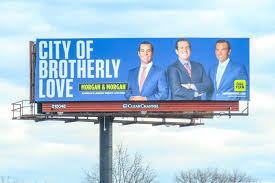
Morgan & Morgan Billboard in Philadelphia

I’ve seen city highways seemingly taken over by lawyers for a long time now. Throughout Nevada, Florida and Arizona, the interstates are littered with promises of fast cash, big cash, and cash in general. I could not begin to tell you which of those attorneys are good or bad—which I guess is part of the point—the consumer selecting counsel off a street sign or a bus is interested in $$$$ and not representative clients or experience in the courtroom (spoiler alert – maybe 50-50?).

For me, though, there is no place like home. And it is on the roads surrounding Philadelphia that brought me the subject for my most recent marketing column, Lawyer Billboard Wars! How Is That Still a Thing? – in the May/June 2025 issue of Law Practice. In an age where almost every spend in law firm marketing is digital, how is it that the billboard is still standing? And not just standing, but thriving? Read on…

Published on:

Shopping CartIt would seem like a no-brainer. You or a family member, relative or friend needs a lawyer. Hey, I’m a lawyer. I know lots of lawyers. That should be easy. But in many cases, it is not. We know the practice areas we know. And in many cases, those are not necessarily typical consumer-facing ones. And I can’t tell you how many times I’ve had commercial real estate attorneys complain to me about getting calls from Jane Doe for a residential commercial real estate transaction. Or an employment lawyer getting a call from John Doe to represent him against the very company that is your client. I remind them that the public does not typically know the difference between plaintiff side and defense, or a real estate attorney handling multi-million-dollar commercial transactions and not interesting in reviewing your kid’s college apartment lease (which many of us have done). This all traces back to us—the “educated” consumer that is a lawyer and needs a lawyer. It should be so simple.

But we often find that it is not always so easy. I doubt many of us in the practice are going to look to advertising for help. We’ll reach out to a variety of colleagues for suggestions and guidance. My most recent marketing column in the January/February 2025 issue of Law Practice, Lawyers Shopping for Lawyers, tackles the business development considerations of the referral source and the challenges that come with marketing (and representing) other lawyers.

If you are blocked from reading the column behind the ABA paywall, it is provided below in its entirety.

Published on:

ethics-regulations-ai-artificial-intelligence-hammer-gavel-judgement-legal_1162612-1423-300x200A few months ago, I was asked to provide the ethics attorney perspective for a Legal Marketing Association (LMA) program, AI for Communications and PR: What You Need to Know Now. At that point, I had not put a lot of thought into the ethical considerations. As with most business development professionals, I had already incorporated artificial intelligence (AI) into my day-to-day. But as is often the case for many lawyer speaking gigs, I delved into the topic and learned it–quickly. And because I believe strongly in taking a presentation and turning it into an article (or vice-versa), my marketing column addresses the issues in the September/October 2024 issue of Law Practice, Ethical Issues When Incorporating AI Into Law Firm Marketing.

Where I come from, when you say “A.I.” it can only mean one thing—Allen Iverson. But in most parts, AI has become a part of our everyday lives—whether we’re talkin’ about practice, not a game, or almost every aspect of business operations (IYKYK). The bottom line is that AI is integrated into almost everything. Thus, the need to understand where the Rules of Professional Conduct (RPC) and other ethical issues in law practice come into play. As I note in my column, no less than 15 different RPCs were noted in one state’s AI task force report, as it relates to potential ethics issues that overlap with law firm marketing concepts.

If you are blocked from reading the column behind the ABA paywall, it is provided below in its entirety.

Published on:

TikTokIn recently reviewing a law advertising campaign, I found myself saying that we need to run this on TikTok. I looked at the matter and the target audience, and it seemed quite clear that this was the best way to engage. My growing fascination with one of the newer online tools—from something I considered a ridiculous kiddie timewaster—to an app that someone sends a link with useful (and/or entertaining) information nearly every day. When it comes to effective law marketing in 2024, you need to know TikTok—and that is why I wrote TikTok Is Gospel to Generation Z in the May/June 2024 issue of Law Practice.
If you are blocked from reading the column behind the ABA paywall, it is provided below in its entirety.

Summary

Published on:

LeadershipIs law firm leadership and law firm marketing synonymous? Or better yet, should they be? I try to answer that very question in the November/December 2023 issue of Law Practice, At the Intersection of Leadership & Marketing.

Please note that if the ABA paywall prevents you from accessing this column, send me an email and I’ll forward you a copy.

The leaders of most law firms—sometimes a managing partner, other times a management or executive committee—are often going to have first and final say on marketing and business development decisions. If not the strategies themselves, then often the dollars approved to staff and finance them. The problem lies in that not all great law firm leaders are great marketing minds.

Contact Information