Marketing Attorney Blog
LPT: Maintaining Ethical Boundaries on the Gray Web of Marketing


ABA’s Law Practice Today Webzine
Being super-active in the American Bar Association’s Law Practice Division means collaboration is a necessity. So in the November 2019 edition of Law Practice Today (LPT), I get to combine my role as Associate Editor of the webzine with my participation in the Ethics & Professionalism Committee to formulate our annual “Ethics Issue.”
Of course, that typically means I will need to contribute a feature as well, so I’ve authored “Maintaining Ethical Boundaries on the Gray Web of Marketing,” which discusses the difficulty many law firms are having today in determining how to effectively and ethically market themselves on the Internet without violating the Rules of Professional Conduct. Suffice it to say–easier said than done. And as the title suggests, it is far from black & white. There are issues of jurisdictional boundaries, fee-sharing, unauthorized practice of law and understanding where the RPC, ethics opinions and enforcement kick in (or don’t). I recently told a colleague that the sophistication level of aggressive online law marketers is well beyond the long arm of the (disciplinary) law. I used to put a ton of time and energy into making sure there was ethics compliance with a “standard” law firm website—text, disclaimers, bar admissions, etc. Today a typical website—regardless of the look & feel—is pretty ho-hum at the end of the day—office locations, bios, practices, industries, representative matters, blah, blah, blah…but it is in the realm of SEO, cookies, social media and all sorts of traffic drivers where the real issues lie below the surface of the World Wide Web. Have a read.
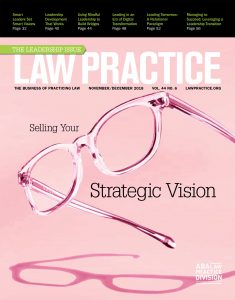
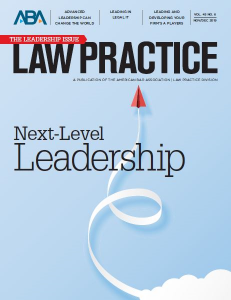 There was some sense of irony that on the same day the latest issue of Law Practice arrived via the U.S. Mail that I was in Philadelphia talking to the Greater Philadelphia Law Library Association at their 2019 GPLLA Institute Bringing a Marketing Mindset into the Law Library program at Drexel’s Kline Institute of Trial Advocacy. You may be wondering how I am going to tie in that speaking engagement into the subject for my marketing column in the November/December 2019 issue of the ABA Law Practice Magazine,
  In the nearly 20 years that I’ve run my law marketing consultancy,
  I read many articles on the morning after an Eagles win in my local newspaper, The Philadelphia Inquirer. On the day after a loss, I read a few less—but win or lose, I enjoy the Up/Down drill that points out the highs and the lows with a thumbs-up, thumbs-down, or simply two thumbs going sideways. So I thought I could copy the concept in what I plan on having as an annual column,
  Perhaps life has really been about search all along. We search for the right job, the right spouse, the right schools, the right restaurants, pretty much the right everything. So Google has either made searching easier, or harder, depending on how you look at it.
 Whenever I pass a roadside diner promising something like “world’s best cherry pie,” I think about lawyer advertising restrictions. Because no law firm or lawyer could tout themselves as the best or greatest—and many of the taglines, phrases and symbols used to market products and services to consumers are restricted or outright prohibited in the legal profession.
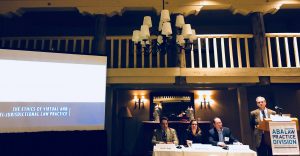 Recently, I had the privilege of serving on a panel at the American Bar Association’s Law Practice Division continuing legal education program on the ethics of virtual and multi-jurisdictional lawyering in Santa Fe, New Mexico. The program was co-sponsored by the State Bar of New Mexico, and took place on May 18, 2018 at the Inn and Spa at Loretto.